


Mobility Network: validations increased by 4.7% during the first half of 2025
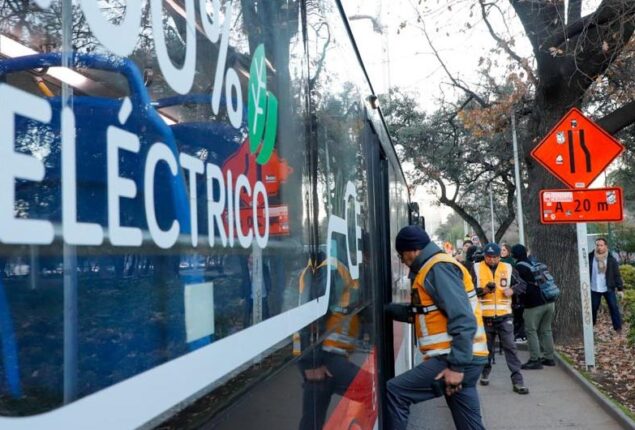
- Between January and June of this year, more than 330 million validations were registered on the system’s buses.
- In addition, a pilot plan is underway to pay for the fare with a biometric system, which would also identify evaders or those who misuse fare benefits.
July 07, 2025.- Within the framework of the Anti-Evasion Plan and the strengthening of the capital’s transport system, the Minister of Transport and Telecommunications, Juan Carlos Muñoz, reported that between January and June of this year, 330 million validations were registered in Red Movilidad buses, which represents an increase of 4.7% compared to the same period in 2024.
This new figure once again confirms the progressive recovery of the system’s demand, which has been strengthened with different actions to improve the travel experience of users, for example, with the enabling of new forms of payment (QR code), incentives such as the Maximum Monthly Amount that allows trips released during the month, but also thanks to the coordinated work between inspectors and Carabineros, with the purpose of detecting and sanctioning those who do not pay the fare.
“We are proud to know that more and more people prefer to use public transport, which has presented a progressive increase in users in the last three years. But this increase in validations is also related to the effort we have made to reduce fare evasion by more than 8 percentage points. Of course we are not satisfied with these figures, which is why we are promoting a bill to toughen the penalties for evaders, but we are also exploring new technological measures to continue strengthening Red Movilidad,” said Minister Juan Carlos Muñoz.
The bill sent by the MTT, called “Pay your Ticket”, proposes a recharged fare to passengers who were found evading, which would be paid on the spot to avoid the fine. In addition, restrictions are established for those people who are on the evader registry, for example, to enter sporting events or to initiate procedures to obtain a passport or residence.
“The balance of the anti-evasion plan until the first half of this year 2025 is positive. The number of validations in the system increased by 38.7% in these three years and we have recovered demand as has not happened since the pandemic. QR payments also increased and today we have 7 times more users validating with this technology since this policy began with the Dale QR benefit. It is a collaborative effort, with public transport companies that add training and controls, especially in paid areas, and that was accompanied by a campaign to call for respect and payment in public transport”, added the director of Metropolitan Public Transport, Paola Tapia.
So far this year, more than 283,000 controls have been carried out together with the Carabineros, in which 27,000 summonses have been issued to the local police court for non-payment of the fare.
“We as tax inspectors work with objectives and one of them is to reduce the rate of evaders in the Red system, and we do this through an increase in controls. For this reason, for this year we set ourselves the challenge of carrying out more than 500 thousand controls. In addition, this year alone we have detected about 2 thousand people misusing the TNE or the Senior Citizen Card. Remember that anyone who does not pay their ticket is exposed to a summons to the local police court and a fine equivalent to 100 thousand pesos.”, said the head of the MTT’s Inspection Division, Óscar Carrasco.
Meanwhile, Lieutenant Colonel Rodrigo Pérez Mujica, of the Prefecture of Traffic and Roads of the Carabineros indicated that “this is a collaborative and permanent work that we carry out with the Ministry of Transport and Telecommunications, on the one hand, to control evasion of the payment of the fare, but also to the safety of passengers who use the system. since this control allows us to detect people with valid orders or other irregular situations that are occurring on public transport.”
Biometric Control Pilot
In the commitment to continue strengthening the public transport system, Red Movilidad began a pilot plan for biometric control in buses on route 406, belonging to the company Metbus.
Through a camera installed at a strategic point, the faces of people who board the bus can be detected and recognized with 98% effectiveness. With this, progress could be made in a facial recognition system for the payment of the fare, but also to identify incivilities, evasion and failure in the use of fare benefits (TNE or TAM).
This is a technology that is already used in Rio de Janeiro to monitor the correct use of fare benefits for students and the elderly, and is also available for the payment of the fare in the Moscow metro, Russia.
For now, this pilot is operating in 5 Red Movilidad buses and will be expanded to 10 machines in the coming days.